

TEOFILA SERVIN BARRIGA
- Jennifer Bjarnason
.jpg/v1/fill/w_320,h_320/file.jpg)
- Aug 18, 2022
- 11 min read
Updated: Aug 18, 2022
ARTIST IN FOCUS

Born July 20, 1966 in the small Michoacan village of Tzintzuntzan, P'urepecha artist Teofila Servin grew up watching her mother embroider. Though she began to learn basic stitches as a child, it wasn't until she was 16 that she began to create more complicated pieces.
Working behind the scenes, it is Teofila's husband who has created the countless designs she then embroiders onto various canvases. Teo creates small and large pieces, from napkins and tea towels, patches and pillowcases to purses, blouses, pictures, rebozos and large-scale wall hangings. Teofila has shown her work in international textile exhibitions in Mexico and the US, has won over 60 awards, and has sold to private collectors from around the world.
A 24 PANEL FOLK ART REBOZO TAPESTRY
We were out during Dia de Muertos on Nov 1, 2018 the night Teofila first presented this incredible rebozo to the public. One of our clients had been looking everywhere for a special collectors piece that represented the Lake Patzcuaro region, and it just so happened that she had booked a separate tour from our group, due to mobility concerns. We knew this would be her piece - but she was leaving the following day and wouldn't have the chance to see it in person. We took photos, and explained how special it was, and sure enough, she sent me back to Teofila's home to purchase it for her. I was thrilled, as this gave me the opportunity to spend one-on-one time with Teofila to ask her about the different designs and their significance, and to photograph the piece in entirety, before I shipped it to our client.
This treasure is a wonderful example of almost every design seen in this particular folk-art medium of the Lake Patzcuaro region. This piece took Teofila more than one year to complete.
PANEL ONE

THE WEDDING
Boda Ranchera translates as "Wedding at the Ranch." This is the first panel on the top left side of the rebozo. This design features the church, musicians, dancing ladies, a woman making a toast with her champagne glass, a woman holding a basket above the area where there is confetti scattered around the lovers, and the bride and groom standing on chairs to create an arch for the 3 single ladies to dance through. Though there are two brides depicted in the scene, it is not a double wedding - but simply a collage of various scenes from the same wedding.
PANEL TWO

COCINA
Cocina means Kitchen in Spanish - and the second panel in Teofila Servin's piece depicts cooking scenes in the Highlands of the Sierra del Madre of Michoacan. A woman stirs broth in a pot that is on a stand over fire. Approaching her is a man with a basket on his back, to represent a net of fish. Closer to the bottom, there is a woman kneeling before another cooking stand. In her hands, she has a white ball like those on the big round pan over the fire. She is making tortillas and cooking them. Behind her is a woman and man on either side of an orange table with two large white onions. They are preparing them for the fish on the fire that are pictured above.
PANEL THREE

LA DANZA DEL PESCADO
The word Michoacan translates loosely as Possessors of Fish, and the Fish Dance is a significant dance here. A young man with a fish on his head represents the fish that the fishermen are trying to catch. Once he has been caught in the net, the women appear and start to serenade the fishermen who have brought home the bounty.
To view this magical dance in action, skip ahead to minute 4:25 from the 2022 K'uenchekua Celebration in Tzintzuntzan, Michoacan
PANEL FOUR

FESTIVAL OF CORPUS CHRISTI
Corpus Christi falls on the Thursday following Trinity Sunday. For this reason, the date changes each year, much like Easter - falling in late May or early June. Corpus Christi festivities in Michoacan can be elaborate, and different from town to town, sometimes lasting a full month. This depiction includes an interesting tradition involving men who must climb a pole that is covered in pig fat. Whoever gets to the top of the pole is able to distribute many gifts that are collected in the basket at the top of the pole. In this scene, we have the musicians, the church, and in the foreground, a man climbs a pole that has a basket of fruit at the top. Around the pole are many people collecting all kinds of gifts. These are the gifts that were in the basket - including fruits and candies.
PANEL FIVE

DOMINGO DE RAMOS
Like Corpus Christi, Palm Sunday falls on a different calendar date each year. Palm Sunday is a huge observation in Michoacan - in fact, Uruapan hosts the largest art market of Mexico each year on the Saturday before Palm Sunday. As Jesus rides God's mule into the city, many are moving to lay down palm fronds before him - signified by a man with the red carpet. This image also shows a many with the Holy Spear, or Lance of Longinus - which pierced Jesus through the side as he hung on the cross. Interesting to note - the people were not celebrating Jesus as a spiritual savior, but as a political leader who had come to overthrow the Romans.
PANEL SIX

NOCHE DE MUERTOS
In this image, one can see many grave mounds that are covered with fruit and candles. These signify the offrendas - or offerings that families make to their ancestors. There are two men digging a grave, and a baby lying in a blanket beside. This represents the 1st of November, when the children who have passed into the other world are celebrated. The orange arch around the top grave represents the marigolds that Muertos is so famed for - as it is believed the arches are gateways between our two worlds, when the veil between them is thinnest. (For those who have observed Dia de Muertos, it may seem confusing that the Vigil del Angellitos takes place on November 1, as the celebrations begin on October 31. These vigils are official at midnight, so the celebrations begin the day prior).
PANEL SEVEN

ARTESANAS
Some sources claim in many households across Mexico, women contribute upwards of 78% of the family income through the sale of their handicrafts - most of which are textiles. Of course men also partake in handicraft production and sale. This image shows many of the arts that are collected from the Lake Patzcuaro region, including the pots of Tzintzuntzan, the hats that are woven in Jaracuaro, furniture from Cuanajo, more pottery from Capula, and the Gabons that are hanging on the tree are a poncho associated with many mountain towns such as Charapan, which is outside of Uruapan.
PANEL EIGHT

VIDA DE RANCHO
This lovely image shows many aspects of local subsistence in the Highlands of Michoacan. There are prickly pear cactus - a plant that offers a nutritious vegetable known as nopal - but also the fruit of the cactus called tuna - or known to us in English as a prickly pear. In this image, there are people feeding chickens, men ploughing the field using man-power, a woman cooking tortillas for everyone, a young girl watering flowers, and a man who is returning from the well with buckets of water suspended across his back. This connection to the land is something that remains common practice among the peoples of the Lake Patzcuaro area - and all of Rural Mexico.
PANEL NINE

NAVIDAD
This beautiful depiction of Navidad in Michoacan is every bit as colourful as Christmas celebrations are in Mexico. Teofila has included angels in the sky with the Star of Bethlehem and fireworks. In the nativity, Jesus is positioned between Mary and Joseph. The Three Kings are arriving with their gifts, and the shepherds guard the stable. But what Mexican Christmas would be complete without a party, including the infamous Mexican Pinata? The man with the red pants and blue blouse is blindfolded - while his friends await the distribution of candy and toys.
PANEL TEN

CARNAVAL
Here we have some new designs to consider! There is a young woman pushing a cart that is full of popsicles and ice-creams. The yellow stand is covered in tasty pastries. Musicians are busy entertaining everyone while the Bull Rider gets tossed around the coral. The one design that had me stumped for quite a while, until we were able to find the translation for it - was the girl with the green branch full of yellow balls. This is actually cotton candy - and the man who is in front of her is spinning cotton candy with the candy machine!
PANEL ELEVEN

DANZA DE LOS VIEJITOS
The Dance of the Old Men is a Purhepecha dance from Jaracuaro, which is a village of the Lake Patzcuaro region of Michoacan. The P'urepecha name for this dance is T'arche Uarakua, and was once only performed by the petámunis, who are the four wise men of the village. The number four is a sacred number for many indigenous groups of the Americas, as there are four seasons, four directions and four elements. There are also four colours of maize, being red, yellow, white and blue. All of these colours have been incorporated into the costumes of the dancers.
In Pre-Colonial time, this dance was performed at the start of each season, and represented renewal. As a result of colonialism, dancers were prohibited from performing this ritual, due to it's spiritual connection to P'urepecha beliefs, though they continued to dance in private. Since that time, young people are permitted to partake in this dance, and the general intent is to mock the Spanish, rather than being connected to seasonal renewal. The dancers now wear clothing that was introduced following contact, though the symbolic colours are incorporated into the jorongos and hat ribbons. It is said that the tapping of the feet and bent back represents the strength of the P'urepecha Culture.
PANEL TWELVE

LAGO DE PATZCUARO
Moving through the different panels of this rebozo, you will be very familiar with many designs now. The couple who are grilling fish over the fire at the lakes edge are familiar. The woman making tortillas by hand and cooking them on those large, flat round pans that are balanced over fire-heated ovens or even cut-out barrels. Beside her we see a small blue platform, where her masa is resting. Then we have the lake, where many egrets are fishing alongside fishermen and fisherwomen - a show of teamwork and patience for what was the most significant form of sustenance in this region.
PANEL THIRTEEN

LAS COMIDERAS
Similar to her depiction of the Kitchen of Michoacan, this one is named after the dining rooms of Michoacan. In this depiction, we have the woman cooking fish - and the man who is bringing fish in a net flung across his back. Behind him is a young corn-maiden cooking atole - which is a hot corn & masa based beverage. There is the molcajete - pictured on the left near the bottom. This is a three-footed stone bowl made from volcanic stone. These are placed over a grill or fire to heat it thoroughly before filling it with delicious cooked meats and vegetables - which are then served with fresh tortillas. Molcajetes are also used as a mortar and pestle for grinding things and mashing fresh salsas.
PANEL FOURTEEN

NOCHE DE MUERTOS
Here we have a second depiction of Noche de Muertos - of Night of the Dead. In this scene, the baby is in a shrine with a candle. The people bring flowers and offrendas to the graves of their loved ones, and there are many fruits represented. Some graves are modest, others extravagant - just as we experience life in the living world. Dia de los Muertos takes place each year on the evening of November 1 and 2nd. Often confused with Halloween, Dia de los Muertos is more connected to Ancestor Worship - or showing respect for family members who have passed away. Sometimes a family may hold special vigil for a particular family member.
PANEL FIFTEEN

BODA TARASCA
Though Tarasca is a term used by the Spanish in reference to the local Purhepecha peoples, the term remains to this day. Named "Boda Tarasca," this scene shows an outdoor indigenous wedding scene - which has many similarities to western weddings due to the Christianization of indigenous peoples in Mexico. One detail in this image, that isn't in the first wedding panel, is a woman in a mauve dress holding a white rosary.
PANEL SIXTEEN

RANCHITO
This scene represents the busy life of the rancher. There is a man carrying water buckets from the well, and a woman gathering water there. Another man has come back from the lake with fish, a woman gathering prickly pears (tuna) from the nopal cactus bush. Behind the fence that divides the animals from where the food is grown, a man plows his field with a wooden plow and horse-power, which is still a common scene from the Ocampo here, while two women scatter Mexico's most important crop - corn.
PANEL SEVENTEEN

CORPUS CHRISTI
In this second depiction of Corpus Christi, we see the celebrations at large - couples dancing, the man climbing the grease-lathered pole, the basket of gifts, and the gifts scattered on the ground that are being collected.
PANEL EIGHTEEN

ARTESANAS
This is the second depiction of the Artisans on Teofila's rebozo - with the furniture makers, basket weavers from Ihuatzio, ceramics from Capula and Tzintuntzan, woven hats from Jaracuaro, and more ceramics from around the Lake Patzcuaro region.
PANEL NINETEEN

DANZA DES TORITO
Cattle were first brought from Spain and the Canary Islands to Santo Domingo in 1493, which was the second voyage of Columbus. From Santo Domingo, the cattle were introduced to Cuba, and finally in 1521, came to Mexico with Gregorio Villalobos and Hernan de Cortes. The origins of the bull dance are difficult to trace, and some locals even claim it predates contact, though were that the case, the animal at the centre of this dance was most certainly not a bull. Regardless, the bull dance is a traditional feature of local celebrations, and includes a bull fabricated from wood covered in colourful paper and other materials, which is passed around among the men, while the women taunt and tease with their serviettes swinging from left to right.
PANEL TWENTY

NAVIDAD
This second depiction of Christmas has a very small flaw - can you see it?
Many cultures believe that only the gods can make something without imperfections, sometimes inspiring artists to make a small mistake on purpose, to remain humble before the eyes of their Creator. In this case, this small mistake was not on purpose, but a reminder that the most beautiful creations in life, are made by hand, even if something small is missed.
PANEL TWENTY-ONE

DOMINGO DE RAMOS
In this second depiction of Domingo de Ramos, we see Jesus riding into Jerusalem on God's mule - this time with a royal carpet rolled out before him. The citizens bring forth many palm fronds to place at his feet - and in the looming distance, the Holy Spears are a reminder that this celebration marks the final days of Jesus' life as a human being on earth.
PANEL TWENTY-TWO

ISLA DE JANITZIO
The statue of Jose Maria Morelos is the key here! This is none other than the small island of Janitzio, which is one of a few small islands of Lake Patzcuaro. The cemetery is featured here, due to its fame and significance related to Dia de los Muertos. Interesting to note the red snake swimming below the boat nearest the bottom of the frame. It is heart warming to see the local community portrayed as a team - such as having two fishermen in separate boats who are netting the same fish together. Communal concepts are a prominent feature of P'urepecha lifestyle.
PANEL TWENTY-THREE

CARNAVAL
In this second depiction of Carnaval, we see the musicians performing, vendors selling pastries and popsicles, and a man selling blue, peach and pink cotton candy.
PANEL TWENTY-FOUR
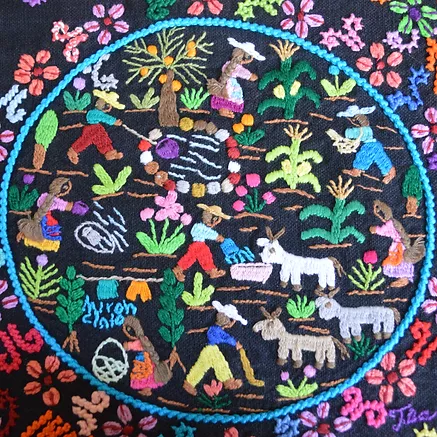
HOMESTEAD
They always say to save the best for last - and this image is truly the most personal gift the artist has given to her piece. Teofila has depicted childhood memories of her own family homestead. This includes growing up with well water before they had plumbing, memories of watering the garden by hand, tending to the farm animals - and a beloved orange tree that is only seen once in this entire piece.
This exquisite piece is part of a private collection in Philadelphia, PA USA. If you would like to own a piece by Teofila Servin, please contact Jennifer for more information at info@soulofmexicotours.com. We can organize an embroidery workshop for you, take you to her studio, or send you photographs of her current work.
THANK YOU FOR YOUR INTEREST IN THIS MEDIUM AND ARTIST'S WORK.

Comments